
Managing paid search at scale is not something you can improvise your way through. Whether you are overseeing campaigns for multiple clients or running complex advertising strategies for a single brand, having the right infrastructure matters enormously. That infrastructure, for most serious advertisers, is Google Ads Manager.
Google Ads Manager, formerly known as My Client Center (MCC), is the centralized platform that allows advertisers and agencies to control multiple Google Ads accounts from a single dashboard. But knowing it exists and actually using it well are two very different things.
In this tutorial, you will get a clear, practical breakdown of how Google Ads Manager works in 2026, what has changed, and how to use its features strategically rather than just functionally. You will learn how to structure account hierarchies, delegate access properly, use bulk management tools effectively, and avoid the common mistakes that slow campaigns down. If you already understand the basics of Google Ads and are ready to operate at a higher level, this guide will give you the framework to do exactly that.
What Is Google Ads Manager?
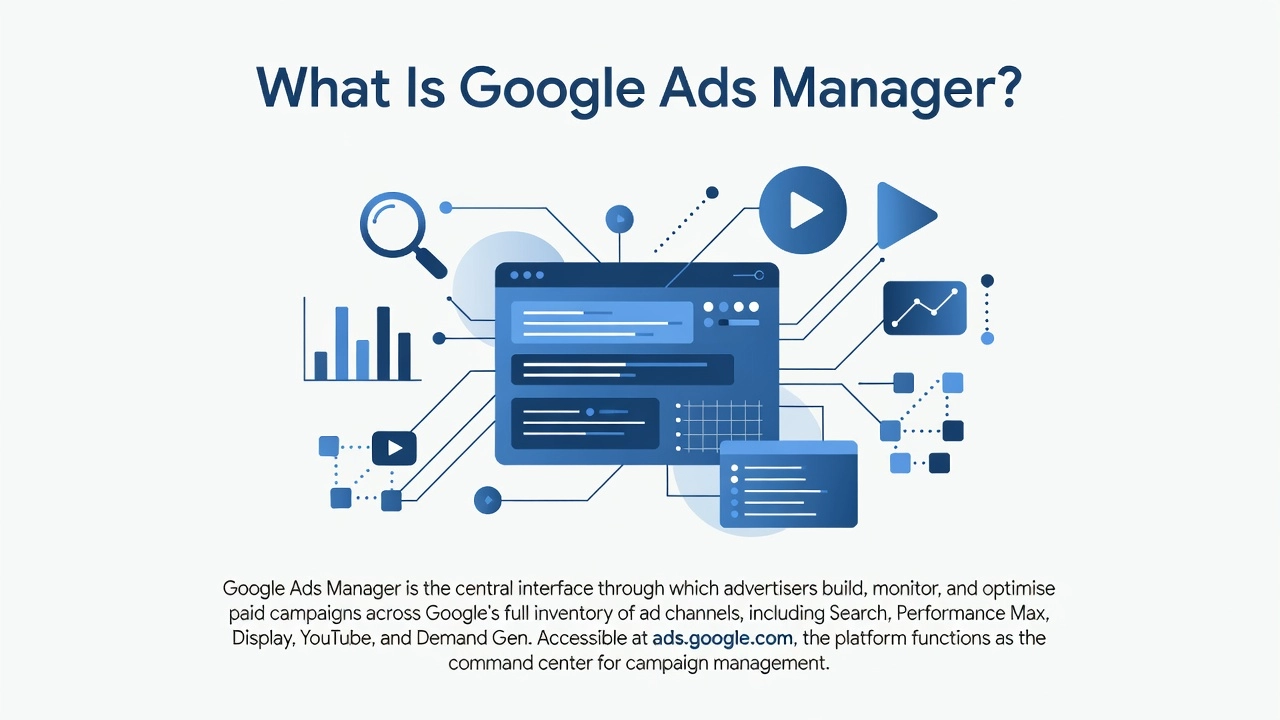
Google Ads Manager is the central interface through which advertisers build, monitor, and optimise paid campaigns across Google’s full inventory of ad channels, including Search, Performance Max, Display, YouTube, and Demand Gen. Accessible at ads.google.com, the platform functions as the command-and-control hub for everything from campaign creation and audience targeting to budget allocation, conversion tracking, and performance reporting. As of 2026, it has formally transitioned to an AI-first architecture, meaning automation now handles a growing share of decisions around keyword mapping, asset selection, and real-time bidding. Google retains 92% of the global search market, making this the platform on which most paid search investment lives and where the margin for error has never been tighter.
One distinction that matters enormously in practice is the difference between the platform itself and the service of managing it professionally. Many business owners conflate the two, assuming that having access to Google Ads Manager is equivalent to knowing how to use it effectively. It is not. The Google Ads Manager 2026 ROI and Insights Playbook frames this clearly: without the ability to assign meaningful values to conversions and feed high-quality signals into Google’s machine learning systems, advertisers are simply generating activity rather than results. Platform access is free and universal; the expertise required to extract commercially meaningful performance from it is an entirely separate matter.
The interface contains several tools that, when used correctly, provide significant strategic advantage. The Performance Planner allows advertisers to model future budget scenarios and forecast their likely impact on conversions and revenue, which is particularly valuable for businesses that need clear budget accountability. Auction Insights gives advertisers direct visibility into competitive dynamics by surfacing metrics including impression share, overlap rate, and top-of-page rate, revealing how campaigns perform relative to others bidding in the same auctions. Automated Rules allow advertisers to set conditional logic that adjusts bids, budgets, or campaign status based on defined performance thresholds, reducing the need for constant manual intervention.
The 2026 upgrades have added meaningful capability to these existing tools. The upgraded Budget Insights dashboard now incorporates predictive analytics, enabling advertisers to anticipate spend fluctuations before they occur rather than reacting after budgets have already been exhausted or underutilised. Enhanced Automated Rules have evolved to support dynamic budget adjustments driven by live performance signals, responding in near real-time to shifts in auction competition, conversion rates, and demand patterns. According to Google’s own announcements, the platform’s 2026 direction centres on helping advertisers create, capture, and convert demand more efficiently through AI-driven innovation.
The core premise this entire guide rests upon is straightforward: the platform is accessible to any advertiser with a Google account, but producing results that justify the investment requires strategic expertise, structured account management, and a clear understanding of how each tool interacts with the broader campaign ecosystem.
The Google Ads Landscape in 2026: Why the Stakes Are Higher Than Ever
Understanding the platform you are working within is not optional when meaningful budget is at stake. The Google Ads environment in 2026 is materially different from the one that existed even two or three years ago, and those differences carry direct financial consequences for any business running paid search campaigns without a clear strategic framework.
CPC Inflation: The Defining Budget Pressure
The most consequential shift is cost inflation. The all-industry average Search CPC has risen approximately 80% since 2021, climbing from $2.69 to an estimated $5.42 as of the most recent benchmark period covering April 2025 through March 2026, according to Google Ads benchmarks data analysed across more than 13,000 US campaigns. This is not a temporary correction. CPC costs rose in 87% of industries over the past year, following an 86% figure the year prior, and a further 8 to 10% increase is projected through Q4 2026. Five structural forces are driving this: Google AI Overviews reducing the organic click supply, Performance Max expanding auction competition across inventory types, privacy signal loss degrading targeting efficiency, Smart Bidding algorithms prioritising conversion value over cost control, and an influx of AI-era entrants flooding high-value verticals. The margin for error in campaign management has never been smaller, and the financial cost of avoidable inefficiency has never been higher.
Performance Max and the Shift in Campaign Architecture
The campaign format landscape has fundamentally changed. Performance Max has become the dominant structure for Google Ads investment, with advertiser adoption rising from 60% in 2024 to 71% in 2025, an 18% year-over-year increase. Estimated US spend on PMax alone is projected to reach $25.6 billion in 2026, making it the fastest-growing single product line in Google Ads history. PMax consolidates Search, Display, YouTube, Discover, Gmail, and Maps into a single campaign driven primarily by Google’s machine learning. This creates genuine efficiency gains when configured correctly, but it also reduces advertiser visibility into where impressions are being served and at what cost, compounding the risk for accounts without structured oversight.
Automation, AI Bidding, and the Oversight Imperative
AI bidding now steers approximately 70% of Google Ads spend. Smart Bidding strategies can reduce cost per acquisition by up to 30% when properly configured, but that qualifier carries enormous weight. Automation optimises toward whatever conversion signal it is given. Accounts with weak conversion tracking, thin historical data, or misconfigured goals can waste budget at scale faster than any manually managed campaign would. Importantly, Quality Score remains a human-managed lever within this automated environment: accounts scoring 8 to 10 pay 37% less per click than the industry median, while accounts scoring 4 or below pay 64% more. The platform being automated does not mean it is self-managing; it means the consequences of poor strategic setup compound faster and with less visibility than ever before.
Why Local and Regional Businesses Face Amplified Risk
Google retains 92% of global search market share as of Q1 2026, and the channel remains the highest ROI platform for the majority of advertisers who use it. The top 10% of advertisers generate 4 times the ROI of the average account, which confirms that platform access is not the differentiator; management quality is. For businesses operating in London and the South East, the stakes are amplified further. Urban markets with dense competitor activity push CPCs above national averages in precisely the sectors that dominate the regional economy. Legal services nationally average $9.87 CPC; dental and healthcare average $8.00; home and property services average $8.33. In a high-density competitive geography like Greater London, where more advertisers are bidding on the same geotargeted searches, Quality Score requirements rise and cost floors push higher still. Professional services, healthcare, construction, and hospitality businesses operating locally are not just competing with the national average; they are competing with every well-funded regional rival bidding on identical intent signals. In that environment, undifferentiated account management does not produce average results. It produces below-average ones, at above-average cost.
Key Features Inside Google Ads Manager That Drive Performance
Understanding which tools inside Google Ads Manager actually move the needle separates advertisers who grow from those who simply spend. Each feature covered below addresses a distinct layer of campaign performance, and knowing how to apply them in combination is what defines expert-level account management.
Performance Planner
Performance Planner allows advertisers to forecast future spend and performance outcomes before committing budget, using historical campaign data combined with current market projections. Rather than guessing what a budget increase might return, you can model specific scenarios, including projected clicks, conversions, and cost-per-acquisition at different spend levels, with forecasts refreshed daily based on the most recent seven to ten days of activity. This makes it particularly valuable for businesses that need clear budget accountability, whether presenting investment decisions internally or planning activity across multiple campaigns simultaneously. One important change to note for 2026: Performance Planner no longer supports planning for Display and Video campaigns as of March 2026, so advertisers relying on those plan types will need to adjust their forecasting workflow accordingly. For Search and Performance Max campaigns, the tool remains an essential pre-spend discipline, especially in an environment where average CPCs have risen approximately 80% since 2021.
Auction Insights
Auction Insights is the competitive intelligence layer built directly into Google Ads Manager, and it is consistently underused by advertisers managing their own accounts. The report surfaces key comparative metrics including impression share, overlap rate, position above rate, top of page rate, and absolute top of page rate, giving you a direct read on how your campaigns perform relative to competitors appearing in the same auctions. Expert managers use this data to diagnose campaign plateaus that have no obvious internal explanation; if your impression share is declining while a competitor’s overlap rate is rising, the problem is competitive pressure rather than account structure. Recovering lost impression share through bid adjustments, quality score improvements, or budget reallocation becomes a targeted decision rather than a guess. Bidding without reviewing Auction Insights is one of the most common and costly habits in DIY account management, and with CPCs rising across 87% of industries over the past year, that margin for error continues to shrink.
Smart Bidding and AI Automation
Smart Bidding strategies, particularly Target CPA and Target ROAS, now sit at the centre of Google Ads performance. When properly configured, Smart Bidding can deliver meaningful reductions in cost-per-acquisition and measurable improvements in overall ad performance, but the results are entirely dependent on the quality of the configuration decisions made upfront. Google recommends a minimum three-week learning runway and at least 60 conversions before adjusting Target CPA or Target ROAS targets; making changes before that threshold resets the learning period and wastes the accumulated signal. Feed quality matters significantly as well, because thin or inconsistent data causes the AI to generate creative outputs that harm Quality Score and drive up costs. The critical point for intermediate advertisers is that handing control to automation does not reduce the need for strategic oversight. It relocates it.
Performance Max
Performance Max campaigns now account for approximately 45% of all Google Ads conversions, with Google’s AI autonomously allocating budget across Search, Display, YouTube, Gmail, Maps, and Discover from a single campaign. That breadth of reach is the appeal, but the reduced transparency makes expert setup non-negotiable. Asset groups must be structured with clear thematic intent, containing up to 15 headlines, 5 descriptions, 20 images, and 5 videos. Audience signals provide directional input to the AI rather than hard targeting restrictions, meaning the algorithm will expand beyond them to find additional users it considers relevant. Negative keywords must be managed at account level since PMax does not support campaign-level exclusion lists, and brand exclusions must be manually configured to prevent the campaign cannibalising branded search terms. When PMax is set up correctly, average CPA reductions of around 18% compared to standard campaigns are achievable after the six to eight week learning period. Without proper structure, the same automation will misallocate spend at scale with limited visibility into where the problem lies.
Budget Insights Dashboard
The 2026 upgrade to the Budget Insights dashboard adds predictive analytics that surface daily spend fluctuations before they compound into larger budget problems. Rather than reviewing performance after budget has already been exhausted or misallocated, the updated dashboard enables proactive decisions based on projected spend patterns. This shift from reactive to anticipatory budget management is particularly relevant for SMBs running campaigns without daily monitoring capacity, allowing a weekly or twice-weekly review cadence without losing control of spend trajectories between sessions.
The Cost of Getting It Wrong: DIY Google Ads and the Management Quality Gap
The performance gap that separates exceptional Google Ads accounts from average ones is larger than most business owners realise, and it has nothing to do with how much budget is being spent. Research consistently shows that the top 10% of Google Ads advertisers generate four times higher ROI than the average advertiser across comparable budgets and industries. That figure deserves careful consideration, because it means the platform itself is not the limiting factor. Budget size is not the limiting factor. The determining variable is management quality: the strategic decisions, the disciplined architecture, the tools being used and, critically, the tools being ignored.
Bidding Without Intelligence
One of the most prevalent and costly DIY failure modes is running campaigns without engaging Google Ads Manager’s Auction Insights report. This tool surfaces six competitive metrics including impression share, overlap rate, and position above rate, giving advertisers direct visibility into how their bidding behaviour compares to competitors in the same auctions. Without this intelligence, businesses allocate budget to auctions they are structurally unlikely to win. The result is wasted impression share, inflated cost-per-click as bids are pushed up by stronger competitors, and a gradual erosion of budget efficiency that is rarely visible in surface-level reporting. Bidding blind is not a minor oversight; it is a systematic drain on campaign performance that compounds month after month.
The Financial Reality at £4,000 Per Month
The numbers make the case clearly. Consider a typical SMB running a £4,000 monthly Google Ads budget. A poorly managed campaign achieving a 1.5% conversion rate generates roughly 30 leads per month from that spend. A well-managed account achieving a 4% conversion rate from identical spend delivers approximately 80 leads, a 167% increase in lead volume for zero additional investment. In a rising cost-per-click environment, that performance gap compounds further each year: the same budget buys fewer clicks as CPCs increase, meaning conversion rate inefficiency becomes progressively more expensive. The business is simultaneously paying more per click and converting fewer of those clicks into enquiries.
Automation Raises the Skill Floor, Not Lowers It
A common misconception is that increased automation simplifies the management task for those without specialist knowledge. The opposite is true. With AI bidding now steering approximately 70% of Google Ads spend, the execution layer is increasingly handled by Google’s systems. However, those systems require accurate conversion data, well-structured audience signals, and coherent campaign architecture to function correctly. An automated bidding strategy trained on incomplete or inaccurate conversion tracking will optimise efficiently toward the wrong outcome. The operational burden has not decreased; it has shifted to a higher and more consequential strategic level, where the cost of a poor decision is amplified by automation at scale.
Five Years of CPC Inflation Have Changed the Stakes
Average Google Search CPCs have risen approximately 80% since 2021, reaching an estimated $4.85 to $5.42 across all industries in 2026, with CPCs increasing across 87% of industries over the past year alone. A campaign management inefficiency that cost a business £400 per month in wasted spend in 2021 now costs closer to £720 for exactly the same structural problem, simply because each click is worth more. What was once a manageable inefficiency has become a material financial loss. For any business currently handling its own Google Ads account at meaningful spend levels, the question is no longer whether professional management would improve performance; it is how much the current performance gap is costing in real terms each month.
How Google Ads Manager Fits Into a Joined-Up Marketing Strategy
Running Google Ads Manager without connecting it to your wider marketing infrastructure is a common and costly mistake. The platform delivers clicks with precision, but clicks are not customers. What happens after someone lands on your page, whether they encounter a slow-loading generic homepage or a well-crafted landing page with a clear call to action and a follow-up email sequence waiting in the background, determines whether that click becomes revenue or waste. Campaign management and marketing infrastructure are inseparable, and treating them as separate responsibilities is one of the primary reasons paid advertising fails to deliver the returns it is capable of producing.
Coordinated Channels Consistently Outperform Isolated Ones
The performance gap between advertisers running a single channel and those coordinating paid search alongside SEO, email nurture, and CRM integration has grown considerably. A prospective client in professional services who clicks a Google Search ad is rarely ready to buy on first contact. They will likely return through organic search, open a follow-up email, or revisit the website before making an enquiry. When those channels are aligned, each interaction reinforces the same message and moves the prospect forward. When they are disconnected, the paid click may generate an enquiry that then falls through the cracks of a business with no nurture sequence in place. Google Ads cannot compensate for what happens outside its interface, making the surrounding marketing system just as important as the campaigns themselves.
Demand Gen and the Full-Funnel Opportunity
Demand Gen campaigns, which reach audiences across YouTube, Gmail, and Discover before they enter the active search phase, are seeing strong spend growth in 2026 as a complement to Performance Max. For businesses with longer sales cycles, including those in construction, healthcare, and professional services, this matters considerably. Waiting for a prospect to search is a reactive strategy. Reaching them earlier, building familiarity and trust before high-intent search behaviour begins, creates a warmer audience that converts more efficiently when it does reach the Search network. This kind of full-funnel thinking requires coordination between campaign strategy and content; it cannot be bolted on to a standalone Search campaign as an afterthought.
Why Integration Determines Profitability in London and South East Markets
For businesses operating across London and the South East, particularly in sectors like property, legal services, and B2B consultancy, the average sales journey involves multiple touchpoints across weeks or months. An integrated agency partner managing paid advertising alongside landing page development, email marketing, and analytics reporting can align the strategic intent across every channel simultaneously. This is not something a business owner managing Google Ads in spare hours can realistically replicate. The operational model that makes paid advertising profitable in high-value, multi-touchpoint markets is a joined-up one; for ambitious businesses in this region, it is not a premium option but a commercial necessity.
What to Expect From a Professional Google Ads Management Service
Knowing what good looks like before you engage a Google Ads management service is one of the most commercially valuable things a business owner or marketing lead can do. Without that benchmark, it becomes impossible to evaluate what you are paying for, or to recognise when a relationship is underdelivering.
Onboarding: The Audit Before Anything Else
A professional managed service does not launch campaigns on day one. It begins with a structured account audit that examines campaign architecture, keyword strategy, match type discipline, bidding configuration, audience targeting, conversion tracking setup, and historical performance data. This diagnostic phase exists because you cannot optimise what you do not understand. Accounts that skip this step frequently carry structural problems that quietly drain budget, including broad match keywords applied without negative keyword controls, campaigns consolidated in ways that make segmented optimisation impossible, and broken conversion tracking that renders all subsequent data unreliable. A poorly structured account can waste between 30 and 50 percent of ad spend on irrelevant traffic, meaning a business spending £4,000 per month may be losing significantly more than that annually before management fees are considered. The audit creates a clear baseline and informs every strategic decision that follows.
What Ongoing Management Actually Involves
Active Google Ads management is not a set-and-forget operation. Proper management of a live account requires consistent weekly work across multiple areas. Negative keyword lists need regular review as new search terms surface through your campaigns. Bid strategies require ongoing adjustment based on performance data rather than passive reliance on automation. Ad copy and creative assets should be systematically tested, with underperforming variants retired and new hypotheses introduced. Audience segmentation needs refinement as behavioural and intent signals accumulate. For Performance Max campaigns specifically, asset groups and audience signals require active curation; the AI optimises based on what it is given, and low-quality inputs produce low-quality outputs regardless of how sophisticated the underlying model is. According to research on PPC management services, 55 percent of companies now outsource their paid search management precisely because this volume of active work exceeds what most internal teams can sustain alongside other responsibilities.
Reporting That Connects to Business Outcomes
Reporting should answer one central question: what did this spend produce for the business? Conversions, cost-per-acquisition, and return on ad spend are the metrics that matter. Impressions, clicks, and click-through rate tell you about activity, not outcomes. A managed service that cannot draw a direct line from your monthly ad spend to leads generated, calls received, bookings completed, or revenue attributed is not providing meaningful accountability. Reports that are dense with platform data but light on business context are a warning sign rather than a sign of expertise.
Account Ownership Is Non-Negotiable
The Google Ads account belongs to the client, full stop. All campaign data, historical performance records, audience lists, and conversion history should sit within an account to which the business retains admin access at all times. Historical data in Google Ads has compounding value; audience lists built over months or years, conversion history that informs Smart Bidding, and campaign performance data that guides future strategy are all assets that cannot be reconstructed if an agency relationship ends badly and access is withheld. A reputable agency will never make account access conditional on the continuation of the commercial relationship.
Communication and Collaboration as Standard
The difference between a genuinely useful managed service and a distant supplier often comes down to how the relationship is structured day to day. Regular reporting cadences, clear escalation when performance shifts, and strategic input that connects platform activity to commercial goals are not optional extras; they are the baseline expectation. Google Ads management services provided by top agencies in 2026 consistently emphasise integration between paid search activity and the broader commercial strategy of the business, rather than treating campaigns as isolated platform exercises. The right managed service operates as an extension of your team, providing honest context when results change and proactive recommendations rather than waiting to be asked.
Making Google Ads Manager Work for Your Business
Google Ads Manager is a genuinely powerful platform, but power and performance are not the same thing. Access to the interface has never been the barrier. The barrier is knowing how to deploy it strategically in an environment where average CPCs have risen approximately 80% over five years, AI bidding steers roughly 70% of spend, and the top 10% of advertisers generate returns four times higher than the average account. That gap is not explained by budget size. It is explained by management quality, strategic oversight, and the ability to connect paid advertising to everything else happening in your marketing.
The cost of getting this wrong has never been higher. For businesses in London and the South East operating in competitive verticals, including professional services, legal, healthcare, construction, and hospitality, poor account management does not just mean lower returns. It means actively wasting budget in a market where every click carries a real commercial cost.
At Daniel and Joseph, we manage Google Ads as part of an integrated growth strategy, not as an isolated activity bolted on to the rest of your marketing. That means your paid campaigns work alongside your website, your SEO, and your wider conversion infrastructure rather than in spite of them.
If you are currently running Google Ads without confidence in what the account is actually delivering, we offer a free Google Ads account audit covering campaign structure, wasted spend, bid strategy alignment, and conversion tracking. You can review current industry benchmarks here before we talk through how your account compares.
To explore how paid advertising fits alongside web design, conversion rate optimisation, and SEO as part of a joined-up strategy, browse our services or get in touch to start a conversation.
Conclusion
Mastering Google Ads Manager in 2026 comes down to a few fundamentals done consistently well. Structure your account hierarchies with intention, delegate access at the right permission levels, and lean on bulk management tools to save time without sacrificing precision. Most importantly, treat the platform as strategic infrastructure rather than just a login portal.
When these principles work together, the difference in campaign performance and operational efficiency becomes impossible to ignore.
If you are ready to take the next step, start by auditing your current account structure today. Identify any permission gaps, redundant configurations, or manual processes that bulk tools could handle faster. Small improvements at the management level compound quickly into meaningful results.
The advertisers who win at scale are not the ones working harder inside their accounts. They are the ones who build smarter systems around them.